
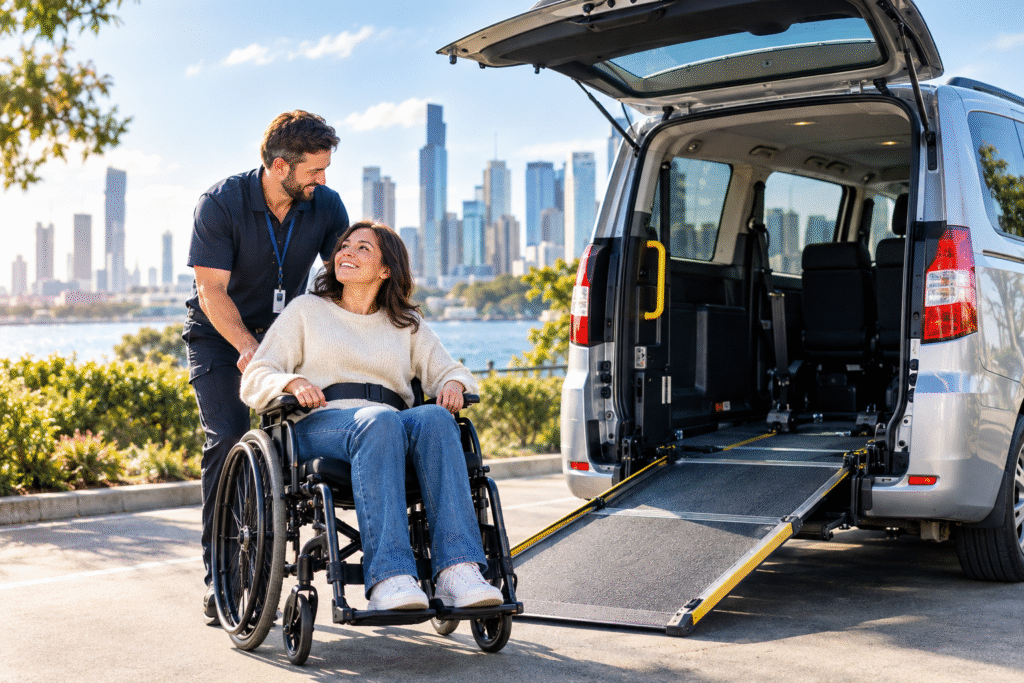
Getting from A to B sounds simple. For millions of Australians living with disability, it is anything but. Inaccessible vehicles, confusing funding rules, and a lack of clear information about what the NDIS actually covers leave many participants stuck at home, missing medical appointments, social events, and the independence they deserve.
This guide cuts through the confusion. Whether you are a first-time NDIS participant trying to understand your plan, a support coordinator helping a client, or a family member doing the research, you will find clear answers here: what the NDIS funds, at which level, how to claim it, and how to book a wheelchair-accessible vehicle (WAV) that meets your needs.
What Is NDIS Transport Funding?
NDIS transport funding is money in your NDIS plan specifically allocated to help you travel when your disability makes it impossible, or very difficult, to use standard public transport independently.
It is important to understand what this funding is not: it is not money to buy or modify a vehicle, and it does not cover everyday travel that any household would need regardless of disability. It is disability-specific. The funding exists because your condition creates an extra barrier to getting around that others do not face.
Transport funding sits inside your Core Supports budget, under Support Category 02. Unlike most Core funding (which you can shift between categories flexibly), transport allowance is a “stated” support, meaning the money is quarantined for transport only and cannot be spent on other Core items.
The End of the Mobility Allowance
If you previously received the Mobility Allowance through Services Australia, note that it has now been phased out for most people. NDIS transport funding has replaced it. Participants transitioning from the Mobility Allowance are reviewed during NDIS planning to ensure their new plan adequately meets their transport needs.
NDIS Transport Funding Eligibility: Who Qualifies in 2026?
Eligibility for transport funding comes down to one central question: does your disability make it impossible, or substantially difficult, to use public transport on your own?
The NDIA considers several key factors when assessing eligibility:
- Your disability prevents independent public transport use (physically, cognitively, sensorially, or psychologically)
- The travel is linked to your disability support needs and your NDIS plan goals such as work, therapy, or community activities
- The support is reasonable and necessary under Section 34 of the NDIS Act
- You have an active NDIS plan that includes transport funding under Support Category 02
What Does NDIS Transport Funding Cover? A Complete 2026 Breakdown
Knowing exactly what is and is not funded saves you from unexpected out-of-pocket costs. Here is a clear breakdown:
| COVERED by NDIS Transport Funding | NOT COVERED |
| Taxi fares to medical appointments, therapy, work, or activities Rideshare services (Uber, DiDi, Ola) for disability-related travel Community transport and accessible buses Travel to employment, study, or day programs Wheelchair-accessible vehicle hire Fuel reimbursement where a carer drives you (at approved rates) Activity-based transport (provider transports you to an activity) | Purchasing a vehicle (see Capital Supports for modifications) General fuel, registration, or car insurance Travel costs for family members or informal carers Overseas or international travel School transport (education system responsibility) Parking or speeding fines Travel unrelated to your disability or NDIS goals |
Activity-Based Transport: A Separate Line Item
Activity-based transport is separate from your personal transport allowance. When a registered provider drives you to a community participation activity as part of delivering a support, they can claim this under support item 04_590_0125_6_1 at approximately $1.00 per kilometre. This does not come out of your transport budget as the provider claims it directly. Confirm current rates in the NDIS Pricing Arrangements 2026-27.
NDIS Transport Funding Levels 2026: Level 1, Level 2 and Level 3 Explained
Your transport allowance is allocated at one of three annual levels, determined by how frequently you work, study, or attend programs. Here is how they compare:
| Level | Annual Amount | Per Fortnight | Who It Applies To |
| Level 1 | $1,784 / year | ~$69 | Not working or studying; seeking community access |
| Level 2 | $2,676 / year | ~$103 | Working or studying under 15 hours/week, or attending day programs |
| Level 3 | $3,456 / year | ~$133 | Working or studying 15+ hours/week; highest transport need |
Transport allowance is typically paid fortnightly directly into your nominated bank account. You do not need to submit individual receipts for these payments. The money arrives automatically and you use it for eligible travel as costs arise throughout your fortnight.
Can I Receive More Than Level 3?
In exceptional circumstances (typically where a participant has complex mobility requirements that genuinely exceed the Level 3 amount) the NDIA may approve higher funding. This requires strong evidence and explicit NDIA approval. It is uncommon, but worth raising with your support coordinator if your transport costs consistently exceed your allocation.
NDIS Transport Funding for Rural and Remote Participants
If you live outside a major city, the NDIA applies the Modified Monash Model, a classification framework that recognises higher transport distances and limited public options in regional areas. Rural and very remote participants may receive higher allocations to reflect the real-world cost of getting around in their community.
How to Claim NDIS Transport Funding Step by Step
The process varies slightly depending on how your NDIS plan is managed. Here is a breakdown by plan type:
Step 1: Confirm Transport Funding Is in Your Plan
Log into myplace on the NDIS portal, or check with your plan manager. Look for Support Category 02 (Transport) in your Core Supports budget. If it is missing, request a plan review to have it added.
Step 2: NDIA-Managed Plans: Money Arrives Automatically
If the NDIA manages your plan, your transport allowance is paid fortnightly directly into your bank account. No receipts are needed for the allowance itself. Keep personal records of how you spend it in case of a future audit or review.
Step 3: Plan-Managed Plans: Submit Receipts to Your Plan Manager
Keep receipts from every taxi, rideshare, or transport provider. Submit them to your plan manager (a photo via an app is usually sufficient). Most plan managers reimburse within one business day.
Step 4: Self-Managed Plans: Claim via the myplace Portal
Log into the NDIS myplace portal, navigate to your active plan, and create a payment request against the transport line. Upload your receipt or invoice. Payment is then processed by the NDIA.
Step 5: Using a Registered Provider: They Invoice Directly
If you book through a registered accessible transport provider, they can invoice your plan manager or the NDIA directly. You do not need to pay upfront and claim back. This is the simplest and most common approach for wheelchair-accessible vehicle bookings.
State-Based Taxi Subsidy Schemes: Extra Savings Alongside NDIS Funding
Here is something many participants do not realise: every Australian state and territory runs its own taxi subsidy scheme for people with disability, completely separate from the NDIS. You can use both at the same time, which significantly stretches your transport budget.
For example: if a taxi costs $40, your state subsidy might cover $20, and your NDIS transport allowance covers the remaining $20. Applied consistently, this can effectively double how far your transport funding goes across the year.
- NSW: Transport for NSW Taxi Transport Subsidy Scheme (TTSS)
- Victoria: Multi Purpose Taxi Program (MPTP)
- Queensland: Taxi Subsidy Scheme (TSS) – extended to 31 December 2026 for NDIS participants
- South Australia: SA Taxi Subsidy Scheme
- Western Australia: Taxi User Subsidy Scheme (TUSS)
- Tasmania: Taxi Subsidy Scheme
- ACT: ACT Taxi Subsidy Scheme
- Northern Territory: NT Transport Voucher Scheme
How to Book a Wheelchair-Accessible Vehicle in Australia
Once you know what your funding covers, the next step is finding a vehicle that meets your actual needs. Not all accessible transport is equal, and booking the right vehicle makes a real difference to comfort, safety, and independence.
What to Look for in a Wheelchair-Accessible Vehicle (WAV)
A properly equipped WAV should include a hydraulic or fold-out ramp or lift, tie-down systems that securely anchor your chair, adequate space for power or manual wheelchairs, air conditioning, and room for a support worker or family members.
Types of Accessible Vehicles Available
- Modified minivans and sedans for individual or paired transport
- Maxi taxis and people movers for small groups
- High-roof vans for powered wheelchairs and scooters
- Larger accessible coaches for group outings or longer journeys
Questions to Ask Before You Book
- Can the vehicle accommodate my specific wheelchair model and dimensions?
- Is there space for my support worker or family members?
- Can the provider supply a correctly formatted invoice for my plan manager?
- Is the driver trained in wheelchair tie-down and restraint systems?
- Do they have experience with NDIS participants and plan management invoicing?
NDIS Transport Funding FAQ: Your Top Questions Answered
Can I use Uber or DiDi with my NDIS transport funding?
Yes. Rideshare services including Uber, DiDi, and Ola are eligible uses of your NDIS transport allowance, provided the travel is disability-related and linked to your NDIS goals. Keep the in-app receipt as your record of the trip.
Does NDIS transport funding roll over if I do not use it?
Transport funding is subject to your plan’s quarterly funding period rules and does not typically roll over indefinitely. Check with your plan manager or support coordinator about any unspent amounts before your plan period ends.
Can my support worker’s travel time be claimed?
Yes. If a support worker accompanies you as part of a funded support, their travel time can be claimed at their standard hourly rate under separate support items. Vehicle expenses such as parking and tolls can also be claimed if agreed upfront in your service agreement.
What if my transport needs change during my plan?
If your transport needs significantly increase (for example, you start a new job or a health change requires more frequent appointments), you can request an early plan review. Document your changed needs clearly and work with your support coordinator to build the case to the NDIA.
Is there a per-trip limit on how many trips I can take?
There is no per-trip limit, only an annual budget limit based on your funding level. Once you reach your allocation, additional travel becomes an out-of-pocket expense unless you have supplementary funding or successfully apply to move to a higher level.
Book Your Wheelchair-Accessible Vehicle with Comfy Travel
Comfy Travel connects NDIS participants across Australia with safe, comfortable, and genuinely accessible vehicles. Whether it is an everyday appointment, a medical visit, or a weekend getaway, their team handles all NDIS paperwork so you can focus on the journey.
With a wide network of vetted providers across metro, regional, and remote Australia, Comfy Travel offers NDIS-compliant invoicing, door-to-door service, and friendly support from a team that truly understands disability travel.
Why choose Comfy Travel:
- NDIS-friendly invoicing – quotes, invoices, and plan coverage support provided
- Australia-wide network – metro, regional, and remote areas covered
- Door-to-door service – arrive on time, every time
- Power and manual wheelchair ready – all equipment accommodated
- Support workers welcome – plenty of space for your whole group
Get in touch today:
Website: comfytravel.com.au
Email: enquiries@comfytravel.com.au
Phone: 0481 433 337
Address: 2/290 Boundary Street, Spring Hill, QLD 4000